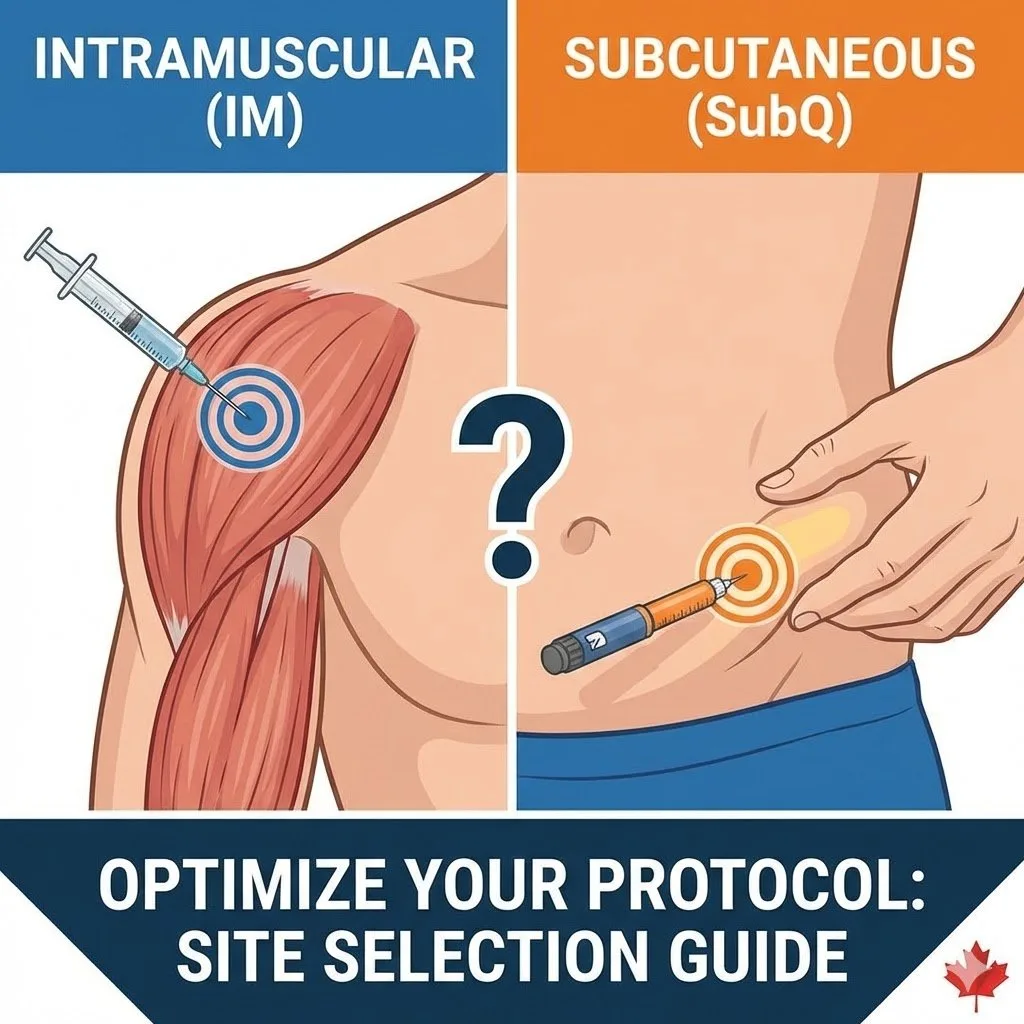
What’s the Best Location for Injections? In the world of performance enhancement, hormone optimization, and recovery, the quality of your product is only half the battle. You could have the purest Testosterone Enanthate or the highest-grade BPC-157 from GH Canada, but if your administration techniq…
In this article
What’s the Best Location for Injections?
In the world of performance enhancement, hormone optimization, and recovery, the quality of your product is only half the battle. You could have the purest Testosterone Enanthate or the highest-grade BPC-157 from GH Canada, but if your administration technique is flawed, you are leaving results on the table—or worse, risking infection and injury.
One of the most common questions we receive is: “Where should I inject?”
The answer is not a simple “here.” The “best” location depends entirely on what you are injecting (oil-based steroids vs. water-based peptides), the volume of the dose, and your personal tolerance for PIP (Post-Injection Pain). Whether you are a seasoned bodybuilder running a heavy cycle or a newcomer looking into TRT (Testosterone Replacement Therapy), understanding your anatomy is the key to safe, painless, and effective administration.
This comprehensive guide breaks down the science of injection sites, comparing Intramuscular (IM) and Subcutaneous (SubQ) protocols, so you can inject with confidence.
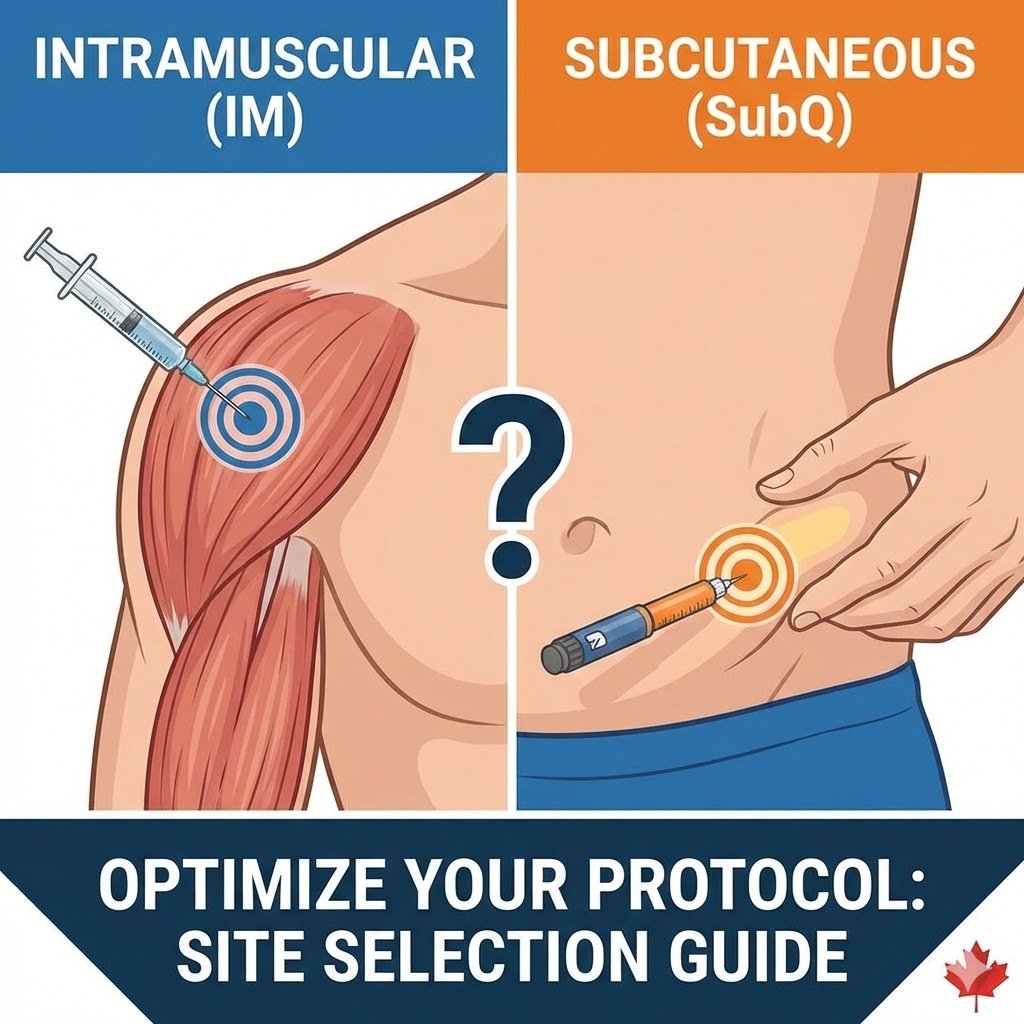
Intramuscular (IM) Injections: The Traditional Route
Intramuscular injections deliver medication deep into the muscle belly, where it is absorbed into the bloodstream via the rich network of capillaries. This has been the gold standard for anabolic steroids and testosterone for decades because muscles can handle larger volumes of oil (1mL to 3mL) better than delicate fatty tissue.
However, not all muscles are created equal. Here are the top sites for IM injections, ranked by safety and ease of use.
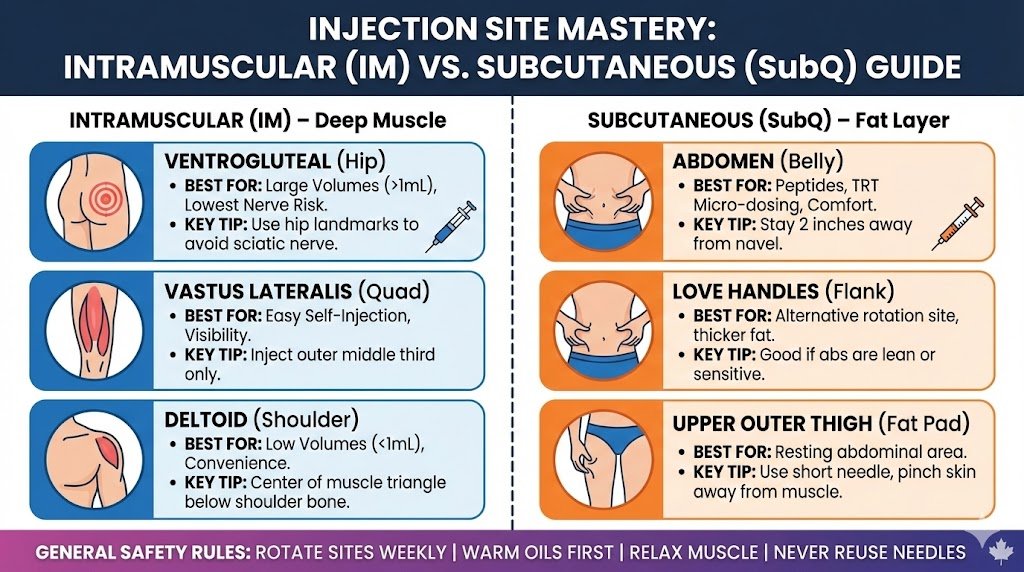
1. The Ventrogluteal (The Gold Standard)
If you only learn one injection site, make it this one. For years, the “upper outer quadrant” of the buttock (Dorsogluteal) was the go-to spot. However, modern nursing guidelines and medical studies have largely abandoned it in favor of the Ventrogluteal site (the hip).
Why it’s the best: The Ventrogluteal muscle is thick, has very little subcutaneous fat covering it, and, most importantly, contains no major nerves or blood vessels. The risk of hitting the sciatic nerve (a common horror story with the Dorsogluteal site) is virtually zero here.
How to find it: It is located on the side of your hip, not your butt cheek. To find it, place the palm of your hand over your greater trochanter (the bony knob of your hip). Spread your index finger to point toward your anterior superior iliac spine (the front hip bone). Inject in the “V” shape formed between your fingers.
Best for: Large volume injections (up to 3mL) and avoiding PIP.
2. The Vastus Lateralis (The Quad Sweep)
The thigh is the most popular site for beginners because it is arguably the easiest to access. You can sit down, see exactly what you are doing, and use two hands if necessary.
Why it’s good: It is a massive muscle group capable of holding substantial volume. It is practically impossible to miss.
The “Middle Third” Rule: You should never inject just “anywhere” in the leg. Visualize your thigh divided into three equal sections from knee to hip. You want to inject into the outer middle third. Injecting too high hits nerves; injecting too low hits tendons. Injecting on the inner thigh is dangerous due to the femoral artery.
The Downside: The quad is a very active muscle. Walking or squatting after a virgin injection here can lead to significant soreness (PIP) for some users.
3. The Deltoid (Shoulder)
The side delt is a classic site for smaller injections. It is convenient and requires very little preparation (just roll up your sleeve).
Why it’s good: Fast absorption and easy rotation.
Limitations: The deltoid is a smaller muscle than the glute or quad. It is generally recommended to limit injections here to 1mL or less. Pumping 3mL of oil into a small deltoid is a recipe for a painful abscess or inflammation.
How to find it: Measure two finger-widths down from the bony acromion process (the top edge of your shoulder). Inject into the center of the muscle triangle below that line.
Subcutaneous (SubQ) Injections: The Modern Approach
In recent years, the landscape of injections has shifted. With the rise of peptides (like BPC-157, TB-500, and Melanotan 2) and the popularity of “micro-dosing” TRT, Subcutaneous injections have become incredibly common.
SubQ involves injecting into the layer of adipose tissue (fat) just beneath the skin. Because fat has fewer nerve endings than muscle, these injections are often virtually painless.
1. The Abdomen (Belly Fat)
This is the most common site for peptides and HGH. It offers a large surface area and is easy to pinch.
How to do it: Choose an area at least 2 inches (5cm) away from your belly button. Injecting too close to the navel can be painful and vascular.
Technique: Pinch an inch of fat between your thumb and forefinger to pull it away from the muscle. Insert a tiny insulin needle (slin pin) at a 45 to 90-degree angle.
Best for: Water-based peptides and small volumes (<0.5mL) of oil.
2. The “Love Handles” (Flank)
If you are lean and struggle to pinch enough fat on your stomach, or if you are tired of pin-cushioning your abs, the flank is an excellent alternative.
Why it’s good: The fat here is often slightly thicker and less sensitive than the front of the abs. It is also out of sight, which some people prefer visually.
Best for: TRT micro-dosing and daily peptide users who need more rotation sites.
3. The Upper Outer Thigh
While the thigh is a muscle site, it also has a layer of subcutaneous fat on top. If you use a short insulin needle (1/2 inch or 8mm) and pinch the skin, you can easily perform a SubQ injection here instead of going deep for IM.
Why it’s good: It allows you to rest your abdominal area.
Note: If you are extremely lean (single-digit body fat), you might accidentally hit muscle here even with a short needle. In that case, stick to the glute or abdomen.
IM vs. SubQ for TRT: Which is Better?
This is a hotly debated topic. Traditionally, Testosterone was always injected IM. However, recent studies and anecdotal evidence from thousands of users suggest that SubQ is equally effective for TRT.
Absorption: SubQ releases testosterone more slowly, which can lead to more stable blood levels and less conversion to Estrogen (aromatization).
Comfort: Using a 29G insulin needle for SubQ is significantly more comfortable than using a 23G or 25G needle for IM “harpoons”.
The Verdict: If you are injecting less than 0.5mL of testosterone at a time (e.g., splitting your dose to twice a week), SubQ is often superior for comfort and stability. If you are blasting a large cycle (e.g., 2mL at once), you must use deep IM to avoid painful lumps under the skin.
The “Forbidden” Zones: Where NOT to Inject
Just as important as knowing where to inject is knowing where not to. Avoiding these areas can save you from nerve damage, paralysis, or severe infection.
The Dorsogluteal (Without Training): As mentioned, the classic “butt shot” carries a risk of hitting the sciatic nerve if you are off by even an inch. Hitting this nerve can cause permanent “drop foot” or chronic pain. Stick to the Ventrogluteal (hip) instead.
Inner Thigh: Never inject the inner thigh. This area is packed with major arteries (femoral artery) and nerves. A mistake here can be life-threatening.
Inflamed or Damaged Skin: Never inject into a mole, a scar, a bruise, or an area that is red and warm. Scar tissue does not absorb oil well, and injecting into an infection can cause it to spread systemically (sepsis).
Mastering the Protocol: Tips for Pain-Free Injections
You have your GH Canada gear, and you have chosen your site. Here are professional tips to ensure the process is smooth and painless.
1. Rotate, Rotate, Rotate
The biggest mistake users make is finding one “favorite spot” and hammering it every week. This leads to scar tissue buildup. Scar tissue is tough, rubbery, and has poor blood flow. If you keep injecting into it, the oil won’t absorb, leading to sterile abscesses or lumps.
The Rule: Never inject the same spot twice in a row. Rotate between left glute, right glute, left delt, right delt, etc..
2. Warm the Oil
Testosterone and other anabolic oils can be thick, especially in colder Canadian winters. Cold oil is hard to push through a needle and causes more trauma to the muscle.
The Trick: Run the vial under warm tap water for 2 minutes before drawing. Alternatively, roll the loaded syringe in your hands or place it in a heating pad for a minute. Warm oil flows like water.
3. Relax the Muscle
If you are tense, your muscle fibers contract and become dense. Trying to push a needle into a flexed quad is painful and causes more tissue damage.
The Fix: If injecting the glute, lie down on your stomach or take weight off that leg. If injecting the quad, sit down and shake the leg loose first. Deep breathing helps.
4. Hygiene is Non-Negotiable
Infections are not caused by the steroid (usually); they are caused by bacteria on your skin or the needle.
Protocol: Always swab the top of the vial. Always swab the skin and let it dry (don’t blow on it!). Never reuse a needle. Needles are cheap; abscess surgery is expensive.
Conclusion
There is no single “best” injection site for every person and every compound. The best site is the one that allows you to administer your dosage consistently, safely, and with minimal discomfort.
For heavy cycles (large volume): Master the Ventrogluteal and Vastus Lateralis IM sites.
For Peptides & TRT (small volume): Embrace the Abdomen or Upper Thigh SubQ sites with insulin needles.
Taking control of your physique requires taking control of your health protocols. By rotating your sites and following safety guidelines, you ensure that your journey with GH Canada products is effective and sustainable.
Ready to upgrade your protocol? Whether you need high-quality Testosterone, healing peptides like BPC-157, or the supplies to administer them safely, GH Canada is your trusted domestic source.
Keep reading
Did Mark McGwire Take Steroids? What He Admitted, and When
Mark McGwire admitted using steroids in a 2010 interview with Bob Costas. Here is the full timeline, from the 1998 androstenedione story to the congressional hearing to the admissi...
Read article
How to Find Superman Pills in Canada
How to Find Superman Pills in Canada: The Truth About Black Market Male Enhancement The hunt for peak sexual performance and absolute reliability in the bedroom often leads men dow...
Read article
Do GLP-1’s Cause Bone Density Loss?
Do GLP-1’s Cause Bone Density Loss? The 2026 Data The explosion of GLP-1 receptor agonists like semaglutide (Ozempic, Wegovy) and tirzepatide (Mounjaro, Zepbound) has fundamentally...
Read article