Letrozole (Femara): The AI of Last Resort, and How to Not Crash
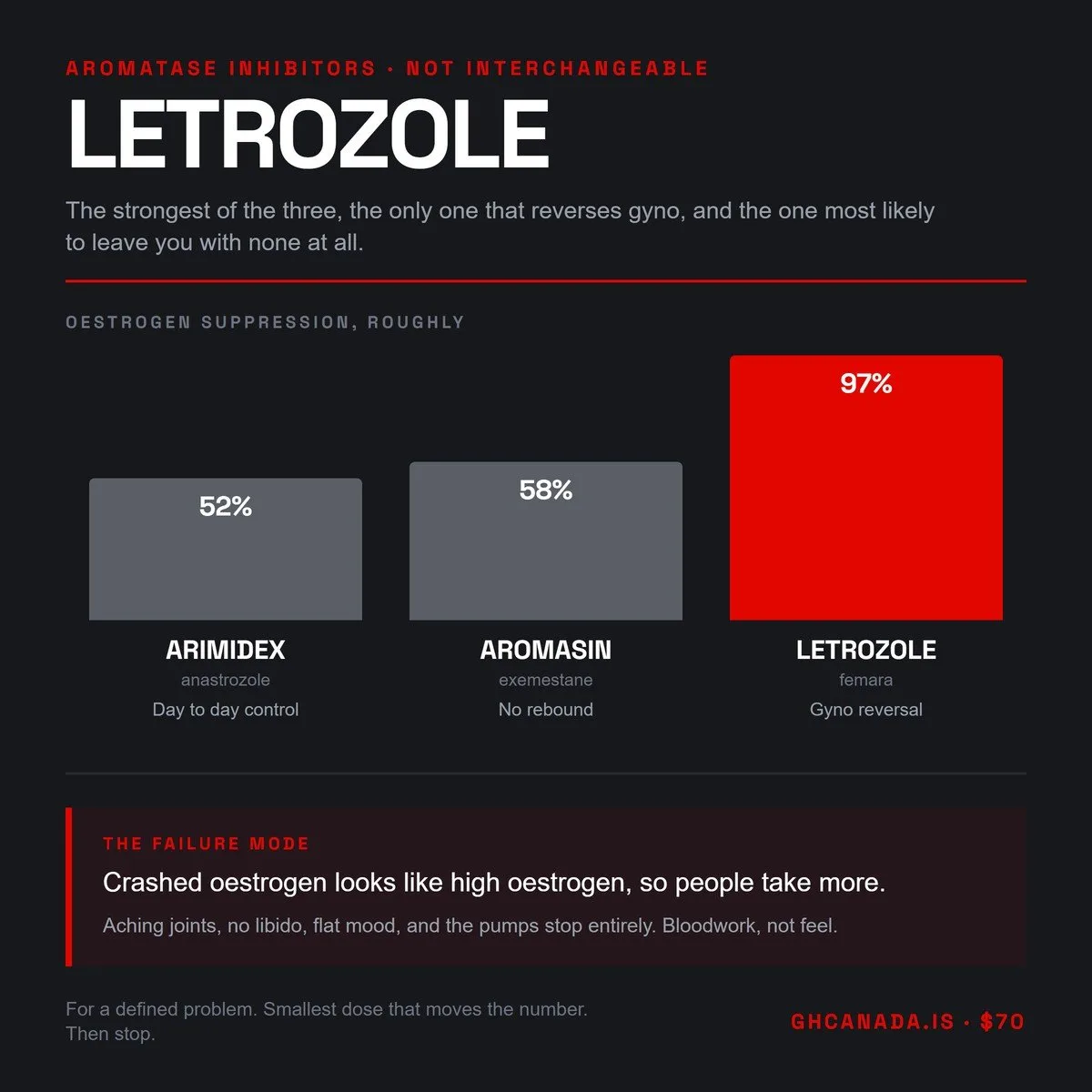
The strongest of the three aromatase inhibitors, the only one that reverses gyno, and the one most likely to leave you with no oestrogen at all.
In this article
There are three aromatase inhibitors in common use and people treat them as interchangeable strengths of the same thing. They are not. Letrozole in particular does something the other two cannot, and it causes a problem the other two mostly do not.
Both of those facts come from the same property, which is that it is far more powerful than the situation usually calls for.
The three, in order
An aromatase inhibitor blocks the enzyme that converts testosterone into oestrogen. All three do that. How hard, and how reversibly, is where they separate.
| Type | Suppression | Usual role | |
|---|---|---|---|
| Arimidex (anastrozole) | Reversible | Moderate | Day to day control on cycle |
| Aromasin (exemestane) | Permanent, per enzyme | Moderate | Control without rebound |
| Letrozole (Femara) | Reversible | Severe | Problems the other two did not fix |
Arimidex and Letrozole are both reversible inhibitors, meaning they occupy the enzyme and then let go. Aromasin is a suicide inhibitor, meaning it destroys the enzyme molecule permanently and your body has to build new ones. That difference matters for rebound, not for strength.
Letrozole is the strongest of the three by a wide margin. In clinical use it suppresses whole-body oestrogen by figures that run well above 95 percent, which is precisely what you want if you are treating hormone-receptor-positive breast cancer, the use it was actually approved for.
It is not what you want if you are a man on cycle trying to keep oestradiol in a sensible range.
Why that is a problem
The mistake people make with this compound is treating low oestrogen as safe because high oestrogen is the thing they were worried about.
Oestrogen in men is not a contaminant. It does real work. It is involved in joint lubrication, bone density, lipid handling, cognition, mood and libido. Men with genuinely crashed oestradiol feel terrible in a way that is distinctive and often misdiagnosed as something else.
What crashed oestrogen actually feels like: joints that ache and click, a complete loss of libido that does not respond to anything, flat affect, poor sleep, and a dry, depleted feeling in the gym where the pumps stop entirely.
That last one is the tell. If your pumps have vanished and your joints hurt, your oestradiol is too low and the AI is the cause, not the solution.
The further problem is that low oestrogen symptoms and high oestrogen symptoms overlap enough that people respond to a crash by taking more AI. That makes it worse. The only way out of that loop is bloodwork rather than guesswork.
The one thing it is genuinely for
Gynecomastia reversal.
This is where Letrozole earns its place on the shelf, and it is the use case the other two handle poorly.
Once gyno tissue has started forming, mild oestrogen control does not undo it. Arimidex can stop it getting worse. Reversing established tissue is a different job, and it requires driving oestrogen down far enough and long enough to deprive the tissue, which is the thing Letrozole is uniquely good at.
The usual approach pairs it with a SERM. Nolvadex at $70 blocks oestrogen at the receptor in breast tissue specifically, while the Letrozole reduces how much oestrogen is there at all. Different mechanisms, same target.
Important caveat: this works on recent, glandular tissue. Gyno that has been there for years has usually fibrosed, and fibrous tissue does not respond to any drug. At that point the only thing that removes it is surgery, and no amount of Letrozole changes that.
Dosing logic, not dosing numbers
The principle that matters more than any figure: this is a compound you titrate down into, not up through.
Letrozole is active at doses far below what people assume. Starting at a dose that sounds reasonable by Arimidex standards will crash you. The practical approach is the smallest amount that moves the number, assessed by bloodwork, adjusted slowly.
Half lives matter too. Letrozole hangs around for roughly two days, which means it accumulates and means that what you took on Monday is still working on Wednesday. People dose daily, feel nothing for three days, take more, and then crash on day five from the stack-up.
And it is not a maintenance compound. Letrozole is for a problem, run until the problem resolves, then stopped. Living on it is how people end up with the joint and lipid picture of a man with no oestrogen at all.
There is also a rebound effect on cessation, because the enzyme was only occupied rather than destroyed. Coming off abruptly can produce an oestrogen spike, which is the argument for tapering down or transitioning to Aromasin at $75 on the way out.
When you should not reach for it
Routine on-cycle oestrogen management. That is Arimidex territory, and using Letrozole for it is using a sledgehammer on a thumbtack.
Water retention you have not measured. Bloat has several causes and oestrogen is only one of them. Sodium, carbohydrate load and the compound you are running all contribute, and an AI does nothing about any of those.
Post cycle therapy. Crushing oestrogen during recovery works against the thing recovery needs, which is your own axis restarting. SERMs are the PCT tool, not AIs.
Anything at all without bloodwork. This compound is specifically the one where you cannot tell by feel, because the symptom sets at both ends of the range look alike.
Questions
Letrozole or Arimidex?
Arimidex for keeping oestrogen in range on cycle. Letrozole for a problem Arimidex has already failed to fix, or for reversing gyno. They are not the same tool.
How fast does it work?
Fast, which is the trouble. Meaningful suppression inside a couple of days, and the long half life means it keeps building after that.
Can it reverse gyno on its own?
Sometimes, on recent glandular tissue, usually alongside a SERM. Never on fibrous tissue that has been there a long time.
Does it cause hair loss?
Not directly. Lowering oestrogen shifts your androgen to oestrogen ratio, and if you are predisposed, that shift is not in your favour.
What happens if I crash my oestrogen?
Stop the AI. It comes back, usually within days to a couple of weeks. The lasting damage from a short crash is minimal, which is the one piece of good news in this article.
Can I use it instead of an AI on a heavy cycle?
It is an AI. If you mean can it replace Arimidex at Arimidex-like doses, the dosing is nothing alike and treating it that way is the single most common way people get hurt with this compound.
The short of it
Letrozole is a specialist tool. It is the strongest aromatase inhibitor available, it is the one that reverses gyno, and it is the one most likely to leave you with no oestrogen, sore joints and no libido if you treat it as a general purpose option.
Use it for a defined problem, at the smallest dose that moves the number, with bloodwork either side, and stop when the problem is gone.
Femara Letrozole, $70 at Golden Health Canada, alongside Arimidex, Aromasin, Nolvadex and Clomid on the ancillaries shelf. Our guide to Arimidex covers the day to day option.
Sold for research purposes. Not approved for human consumption and not intended to diagnose, treat or prevent any condition. Aromatase inhibitors affect bone density, lipids and cardiovascular health. Prices current October 2026.
Keep reading

What Thymosin Alpha-1 Does and What the Trials Found
Thymosin alpha 1 gets lumped in with healing peptides like BPC-157 and TB-500, mostly because of the name. It is a different thing. It does not repair tissue. It is an immune pepti...
Read article
What Is Cagrilintide?
A weekly amylin shot that, paired with semaglutide, produced 22.7 percent weight loss in REDEFINE 1. How it works, the side effects, and where approval stands.
Read article
Tesamorelin in Canada: What It Is, What the Trial Found, Where to Get It
Tesamorelin is the rare peptide with a Canadian story and a proper clinical trial behind it. It was developed by a Montreal company, approved by Health Canada, and tested in a rand...
Read article