IGF-1 LR3, DES and Native: Which One Are You Actually Buying
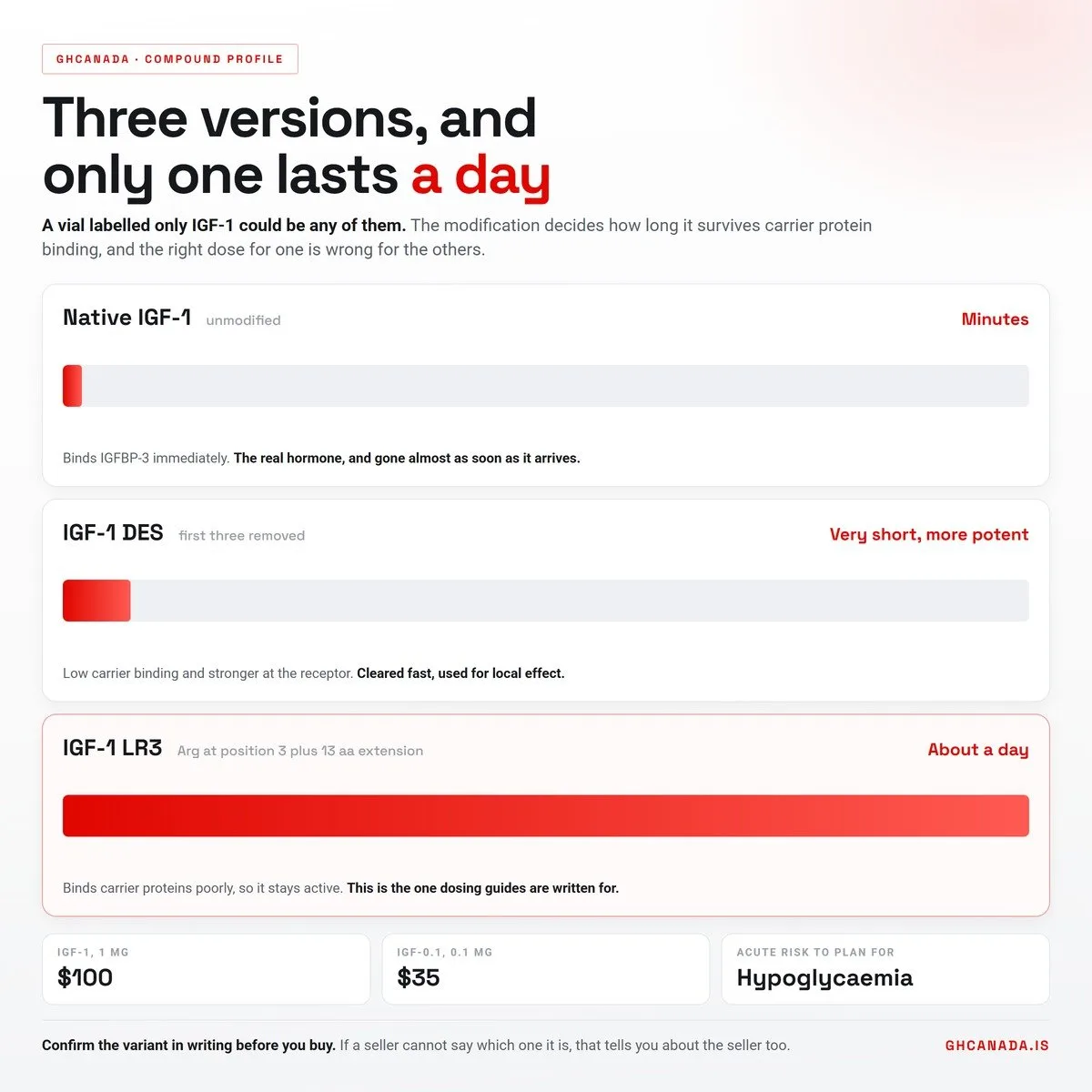
Three versions circulate and only one lasts a day. What LR3, DES and native IGF-1 actually are, why the dose differs, and the risk to plan around.
In this article
Nearly every question about IGF-1 LR3 is actually a question about which version you are holding, and most listings do not say.
There are three forms in circulation, they behave completely differently, and the difference is hours versus minutes. Get that part right and the dosing questions answer themselves.
What IGF-1 is before anyone modifies it
Insulin-like growth factor 1 is a 70 amino acid hormone your liver already makes, mostly in response to growth hormone. A large part of what GH does, it does by causing IGF-1 to be released.
That is the first thing worth understanding. If you are already running growth hormone, you are already raising IGF-1. The two are not separate levers, they are the same lever at different points in the chain.
Native IGF-1 in the bloodstream is almost entirely bound to carrier proteins, chiefly IGFBP-3. Bound means inactive but protected. Free IGF-1 is active and is cleared within minutes. That binding is the whole reason the modified versions exist.
The three versions, which is the part that matters
| Form | What was changed | Practical effect |
|---|---|---|
| Native IGF-1 | Nothing | Binds carrier proteins immediately. Active window measured in minutes |
| IGF-1 LR3 | Arginine swapped in at position 3, plus a 13 amino acid extension on the front | Binds carrier proteins poorly, so it stays active far longer. The figure usually cited is in the region of a day |
| IGF-1 DES | First three amino acids removed | Very low carrier binding and more potent at the receptor, but cleared extremely fast |
LR3 is the one people mean when they say IGF-1, because it is the one that survives long enough to be worth injecting. DES is the opposite approach: short, sharp, used by people who specifically want a local effect rather than a systemic one.
Native IGF-1 sits awkwardly between the two. It is the real hormone, and it is gone almost as soon as it arrives.
Read the label before you read the dose
Here is the practical problem. A vial labelled simply IGF-1, with no variant named, could be any of the three, and the correct dose for one is wrong for another.
Dosing advice that circulates online is almost always written for LR3 without saying so. Applying an LR3 protocol to DES means dosing something far shorter acting as if it lasts a day. Applying it to native IGF-1 means most of it is bound and gone before it does anything.
So the rule is simple and it comes before every other question: confirm the variant, in writing, before you buy. If a seller cannot tell you whether it is LR3, DES or native, that tells you something about the seller as well as the product.
We stock IGF-1 at 1 mg for $100 and IGF-0.1 at 0.1 mg for $35. If the variant matters to your plan, ask us before ordering rather than after.
Why the 0.1 mg exists
A tenth of a milligram looks like a strange thing to sell next to a full milligram, and the reason is reconstitution.
IGF-1 is dosed in micrograms. A 1 mg vial is 1000 mcg, which at typical protocols is a lot of doses out of one vial, and every one of them depends on you measuring correctly from a reconstituted solution that then has to be stored.
The smaller vial is the sensible way to find out whether you respond to it at all, and whether you can handle the measuring, before you have 1000 mcg sitting in your fridge degrading on a clock.
The one risk to actually plan around
IGF-1 has meaningful insulin-like activity. That is not a figure of speech, it is in the name, and it is the acute problem.
Hypoglycaemia is the realistic adverse event: shakiness, sweating, confusion, and in a bad case considerably worse. It is dose dependent and it is worse on an empty stomach. Anyone using IGF-1 should know what low blood sugar feels like in themselves, should not be dosing and then going to sleep or driving, and should have fast carbohydrate within reach rather than in a cupboard downstairs.
This is also why stacking it casually with insulin is a genuinely dangerous idea rather than an aggressive one.
Beyond that, the honest position is that long term human safety data for the modified analogues does not exist, because they were never developed as medicines for this purpose. Anyone telling you the long term risk profile is known is guessing.
Handling and storage
Lyophilised powder is stable refrigerated. Once reconstituted, it is a peptide in solution and it is on a clock, so it stays cold and it does not get shaken.
Bacteriostatic water rather than sterile water, because you will be drawing from the vial more than once. Our guide to spotting fake growth hormone covers the same inspection logic that applies here: look at the cake, look at the seal, look at what the vendor will put in writing.
Where it fits, honestly
IGF-1 is not a beginner compound and it is not a replacement for anything. It sits downstream of growth hormone, it carries an acute risk that most compounds in this category do not, and the modified versions are research chemicals rather than medicines.
If you are considering it, the sequence that makes sense is bloodwork first, a clear reason second, the smaller vial third, and a protocol written for the variant you actually bought rather than the one the internet assumed.
The rest of the range sits in peptides, and if growth hormone is the actual goal, the HGH pricing guide is the more direct route.
Sold for research purposes. Not approved for human consumption in Canada and not a licensed medicine. General information only, not medical advice. Speak to a doctor about anything affecting your health.
Keep reading

What Thymosin Alpha-1 Does and What the Trials Found
Thymosin alpha 1 gets lumped in with healing peptides like BPC-157 and TB-500, mostly because of the name. It is a different thing. It does not repair tissue. It is an immune pepti...
Read article
What Is Cagrilintide?
A weekly amylin shot that, paired with semaglutide, produced 22.7 percent weight loss in REDEFINE 1. How it works, the side effects, and where approval stands.
Read article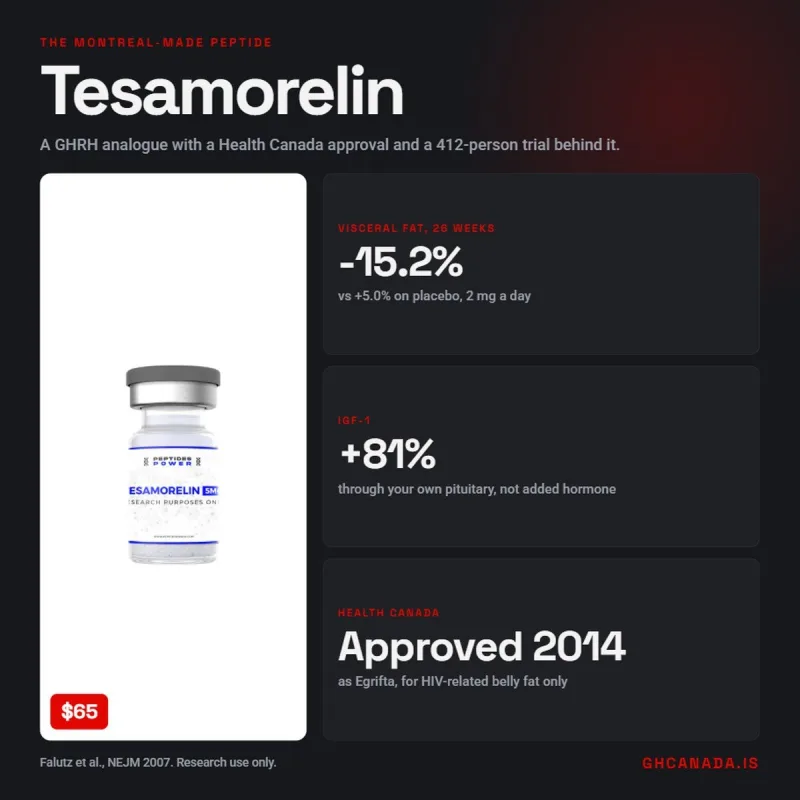
Tesamorelin in Canada: What It Is, What the Trial Found, Where to Get It
Tesamorelin is the rare peptide with a Canadian story and a proper clinical trial behind it. It was developed by a Montreal company, approved by Health Canada, and tested in a rand...
Read article